The arcsine law: how long a random walk spends on one side of zero
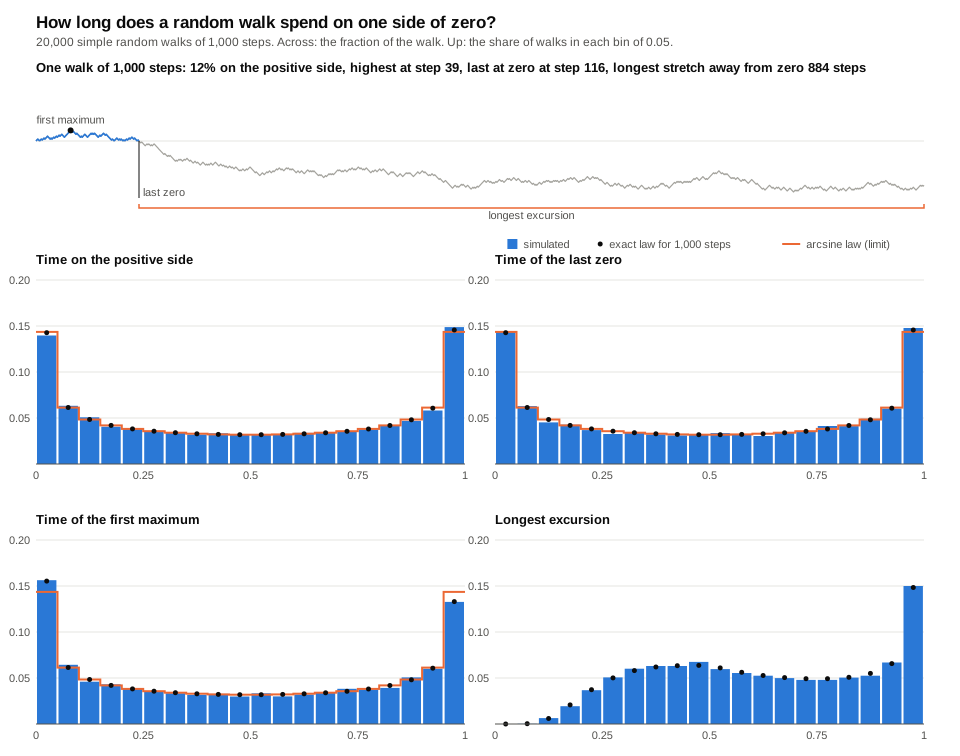
Flip a fair coin a thousand times, stepping up on heads and down on tails, and keep track of how much of the time the walk is above where it started. Intuition says about half. It isn't. A walk is far more likely to spend nearly all of its time on one side than to split its time evenly: the fraction follows the arcsine law, whose density 1 / (π √(x(1−x))) is lowest in the middle and climbs without bound at the two ends. This project simulates 20,000 walks, measures four things about each, and puts the histograms beside the exact laws.
Run
python projects/arcsine/arcsine.py                                         # 20,000 walks of 1,000 steps; summary as text
python projects/arcsine/arcsine.py --out projects/arcsine/out/arcsine.svg  # and write the chart
python projects/arcsine/arcsine.py --exact-longest                         # the longest excursion's exact mean, and the final-stretch probability, at every round length up to 1,000 steps
python projects/arcsine/arcsine.py --exact-longest --steps 4000            # the same up to 4,000 steps, about six seconds
python projects/arcsine/arcsine.py --exact-longest --steps 2000 --out projects/arcsine/out/longest.svg  # and the chart of it below
pytest projects/arcsine
How it works
- A walk of m steps is one
getrandbits(m)call turned into ±1 steps and run throughitertools.accumulate. Twenty thousand walks of a thousand steps take about two seconds. - Four measurements per walk. The time on the positive side counts, in Feller's sense, the unit intervals during which the path is above the axis: the interval from k−1 to k counts if S(k−1) > 0 or S(k) > 0, so a walk that touches zero and goes straight back up never leaves the positive side, and the count is always even. The last zero is the last time the walk is at 0. The first maximum is the first time the walk is at its highest point (0 if it never rises above its start). The longest excursion is the longest stretch between visits to zero, counting the unfinished stretch after the last one.
- The exact laws are Feller's (An Introduction to Probability Theory and Its Applications, volume 1, chapter III): for a walk of 2n steps, the time on the positive side is 2k with probability u(k)·u(n−k), where u(k) = C(2k, k) / 4^k is the probability of being back at zero after 2k steps, and the last zero is at time 2k with the same probability. The first maximum is at time 0 with probability u(n) and at time k ≥ 1 with probability u(j)·u(n−j) / 2, where j = ⌊k/2⌋: the k steps before it, read backwards, are a walk that stays strictly positive, and the steps after it are a walk that stays at or below zero. Times 2j and 2j+1 together carry the arcsine atom u(j)·u(n−j), so all three tend to the same limit, P(fraction ≤ x) = (2/π) arcsin √x, but the ends differ: the atom at 0 is whole and time 1 carries another half of it, while the atom at 2n is halved, which pays for that since the two end atoms are equal. That's the tie-break. A walk that never rises above zero has its first maximum at time 0 whatever it does afterwards, while a maximum at the last step has to be a strict one. The last maximum has the mirror image of this law. A test enumerates every walk of up to ten steps and checks all three counts against the formulas exactly, in fractions.
- The longest excursion has no formula I know of, so its exact distribution comes from a renewal recursion. Let g(t) be the probability of being at zero at time 2t with every completed excursion at most 2ℓ long; then g(t) = Σ f(j) g(t−j) over the first-return probabilities f(j) = u(j−1) − u(j) with j ≤ ℓ, and the longest excursion is at most 2ℓ with probability Σ g(t)·u(n−t) over the t whose unfinished final stretch of 2(n−t) steps is also short enough. Two shortcuts keep it quick: up to t = ℓ nothing can be too long, so g(t) = u(t), and up to t = 2ℓ at most one excursion can, so g(t) = 2u(t) − u(ℓ), because a bridge of 2t steps holds an excursion of length 2j with probability f(j) whatever happens around it and the too-long ones telescope to u(ℓ) − u(t). After that the recursion runs as a dot product in C.
- The chance that the final stretch is the longest is Σ g(t)·u(n−t) with ℓ = n−t, so the rows for every ℓ serve every walk length at once, and one pass gives the probability at every even length up to the one asked for. The mean longest excursion comes from those for free, by an identity that holds walk by walk: two more steps lengthen the longest excursion by exactly two when the final stretch was already at least as long as every completed excursion, and by nothing otherwise (whether or not the walk is back at zero at the new end, the new longest is the larger of the longest completed excursion and the old final stretch plus two). So the mean grows by twice the probability at each length, and the means are running sums. Both were cubic-time recursions that stopped at a few hundred steps; the whole table is still cubic in principle, about (n/2)³/54 multiplications for n steps, but 1,000 steps now take a fifth of a second and 4,000 about six. Everything is checked against the enumeration of every short walk, and the identity is checked on every walk of up to ten steps and every way of extending it.
- The limit of both is Brownian motion's, and there it is an integral. Brownian motion's excursions away from zero, ordered by local time at zero, are a Poisson process whose lengths have the measure ν(dx) = x^(−3/2) dx / (2√π), so ν̄(a) = 1/√(πa) of them per unit of local time are longer than a. Stop the motion at an exponential time T of rate 1; by scaling, the chance that the final stretch is the longest is the same at every fixed time, so it is the same at T. The final stretch is the longest, of length a, when the motion reaches some local time L with every excursion so far shorter than a (and T not yet reached), then enters an excursion longer than a and meets T a into it. Integrating over L and a gives ∫₀^∞ e^(−a) ν̄(a) da / (ν̄(a) + ∫₀^a (1 − e^(−x)) ν(dx)), and working out the inner integral leaves ∫₀^∞ da / (1 + √(πa) e^a erf √a). Simpson's rule on [0, 40] gives 0.6265075988. That is the renewal sum above with the walk replaced by Brownian motion, so it is the same argument, but it is computed a wholly different way.
- The chart is hand-written SVG: one sample walk, then four histograms with the exact law as dots and the arcsine law as an orange staircase. The staircase is the probability the limit law gives each bin, not its density, so the end bins compare honestly with the bars. A test regenerates the chart and checks that the committed file matches. The second chart,
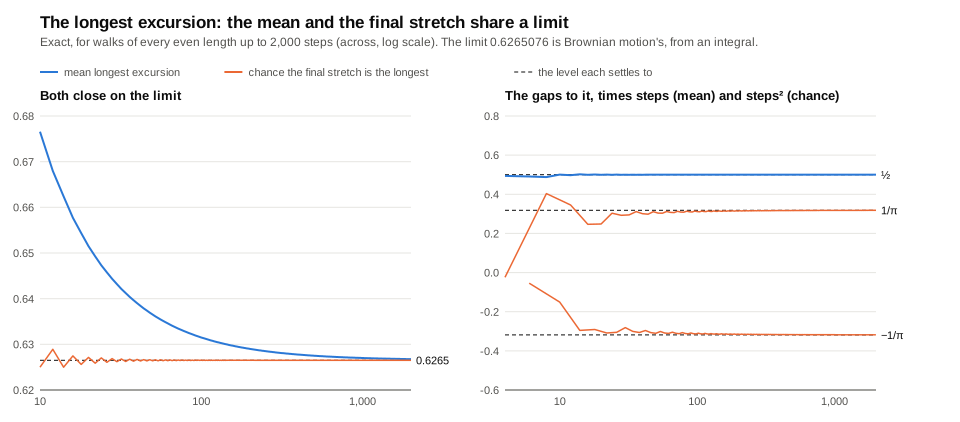
out/longest.svg, draws the exact table for every even length up to 2,000 steps on a log scale, with the same test.
What I found
The middle is the least likely place. Of 20,000 walks of 1,000 steps, 41.2% spent at least nine tenths of the time on one side (the exact law says 41.3%, the limit 41.0%), and only 13.1% split their time anywhere between 40/60 and 60/40 (exact 12.9%). The mean fraction is one half, 0.5003 measured, and almost nothing is near it.
Three quantities, one law. The time of the last zero has the same distribution as the time on the positive side, atom for atom, and the time of the first maximum has it up to the tie-break at the ends. The simulation agrees with all three: Kolmogorov distances of 0.005, 0.006 and 0.004 over 20,000 walks, against a typical 0.007 for that many samples.
At a thousand steps the limit has arrived. The exact law and the arcsine law differ by less than 0.001 in every bin but the top one. That bin is closed at 1 where the others are half-open, so it holds one more atom of the discrete law than the bottom bin does; the 0.002 gap there is the binning, not the law.
The maximum leans early, and the lean is exactly the tie-break. A walk of 1,000 steps never rises above its start with probability u(500) = 0.025, and then its first maximum is at time 0. The chart shows the consequence: the first bin holds 0.155 of the walks (0.156 simulated) where the arcsine law gives 0.144, and the last bin 0.133 (0.133 simulated). The maximum comes in the first tenth of the walk for 21.8% of walks and in the last tenth for 19.4% (22.2% and 19.3% simulated), and its mean time is (n + ½)(1 − u(n)) rather than n: 0.488 of the walk (0.487 simulated). In the limit the atom at 0 vanishes and the lean with it, which is why Feller can call this the third arcsine law; at a thousand steps it is still plainly there in the picture.
The longest excursion is not arcsine. Its distribution is a broad hump around four tenths of the walk with a spike at the top, and the recursion's dots sit on the simulated bars. Its mean is 0.626 of the walk's length at 1,000 steps, and the unfinished stretch after the last zero is the longest one in 62.3% of walks. The first pass found those two numbers within noise of each other, computed both exactly, and concluded they were a coincidence: the exact mean was still falling with the walk's length while the probability had settled at 0.6265. Both facts were right and the conclusion was wrong. The identity above says the mean is the running average of the probability over all the shorter lengths, so the two have the same limit, and the mean lags because the probability was higher for very short walks (it is 1 for a walk of no steps and ½ for two). What --exact-longest --steps 4000 prints:
steps   mean fraction   final stretch is longest   (mean - final) x steps
   10        0.676562                   0.625000                    0.5156
   20        0.651480                   0.627129                    0.4870
   50        0.636510                   0.626384                    0.5063
  100        0.631507                   0.626539                    0.4969
  200        0.629008                   0.626515                    0.4984
  500        0.627508                   0.626509                    0.4994
 1000        0.627008                   0.626508                    0.4997
 2000        0.626758                   0.626508                    0.4998
 4000        0.626633                   0.626508                    0.4999
So the probability reads 0.626508 at 1,000 steps and beyond, the mean longest excursion is that fraction of the walk plus what looks like exactly half a step, and the first pass's "0.0005 apart at 1,000 steps" was ½ / 1,000. The probability wobbles on its way in: it is exactly 5/8 for walks of 4, 6, 10 and 14 steps and not for 8, 12 or 16.
The constant is an integral, and the wobble is 1/π. The third pass derived the Brownian limit above and computed it: 0.6265075988, which is where the recursion was heading. --exact-longest now prints it and measures both gaps against it:
steps   mean fraction   final stretch is longest   (mean - limit) x steps   (final - limit) x steps^2
   10        0.676562                   0.625000                    0.5005                      -0.1508
   20        0.651480                   0.627129                    0.4995                       0.2484
   50        0.636510                   0.626384                    0.5001                      -0.3101
  100        0.631507                   0.626539                    0.5000                       0.3113
  200        0.629008                   0.626515                    0.5000                       0.3146
  500        0.627508                   0.626509                    0.5000                       0.3169
 1000        0.627008                   0.626508                    0.5000                       0.3177
 2000        0.626758                   0.626508                    0.5000                       0.3180
 4000        0.626633                   0.626508                    0.5000                       0.3181
The mean's gap is half a step to four places from 100 steps on. The probability's gap, scaled by the square of the length, settles on ±1/π = ±0.318310 with the sign set by the length mod 4: it is 0.3181 at 4,000 steps, three digits of agreement, and the difference, 0.00019 there, roughly halves each time the length doubles. So, empirically,
P(final stretch is longest) ≈ 0.6265075988 + (−1)^(steps/2) / (π · steps²),
and the mean is the limit plus ½ step. I haven't proved the 1/π; it comes out of the numbers, not an argument. The chart shows both:
On the references: the integral is the form I remember from Godrèche, Majumdar and Schehr's work on the longest excursion, and as I remember it the constant is also the mean largest part of Pitman and Yor's Poisson–Dirichlet partition with parameters ½ and 0. I still couldn't check either from here, and I no longer need to: the recursion over walks and the integral over Brownian motion are separate computations, and they agree to ten digits. Whatever the papers say, 0.6265075988 is the number.
The sample walk. The first walk the seed produces is on the positive side for 12% of its time, is first at its maximum at step 39, is last at zero at step 116, and then stays below zero for 884 steps. By the law, that's an ordinary walk.
Files
arcsine.py: the walk, the four measurements, Feller's laws, the renewal recursion and the identity that makes the mean a running sum, the binning, the chart, and a small CLI.test_arcsine.py: the measurements on hand-made walks; every law against the enumeration of all walks up to ten steps; the identity on every walk of up to ten steps and every extension of it; the recursion at 1,000 steps against the numbers above; the simulation against the laws; the binning; the chart's contents; the CLI; and that the committed chart matches the code.out/arcsine.svg: the chart, 32 KB.out/longest.svg: the longest excursion's exact table against its limit, 24 KB.