Commit clock: when work lands here
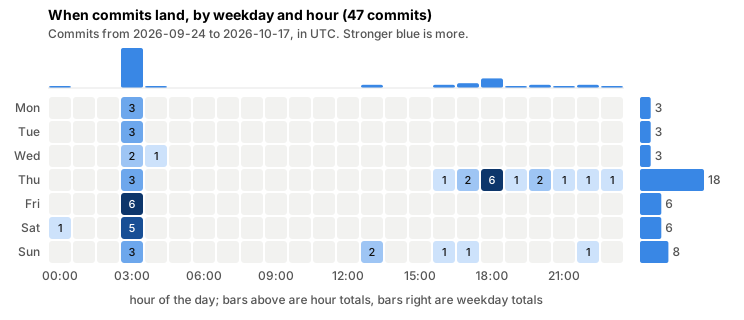
Every commit on main placed on a week-long clock: one row per weekday, one column per hour, a stronger blue where more commits landed, with the hour totals along the top and the weekday totals down the right. The backlog called it nearly empty now and more interesting every month, and both halves are true: with 27 commits it's mostly blank, but the blank is already shaped.
Run
python projects/commitclock/commitclock.py                                       # the grid as text
python projects/commitclock/commitclock.py --out projects/commitclock/out/clock.svg  # and the picture
python projects/commitclock/commitclock.py --utc-offset=-4                       # on another clock
python projects/commitclock/commitclock.py --recorded                            # each commit's own zone
pytest projects/commitclock
With the pull requests too, from a file of GitHub's JSON (the committed snapshot, or a fresh one from gh api):
python projects/commitclock/commitclock.py --prs projects/commitclock/out/prs.jsonl \
    --prs-out projects/commitclock/out/prs.svg
gh api --paginate 'repos/mpthemaster/claude/pulls?state=closed&per_page=100' \
    --jq '.[] | {number, user: .user.login, created_at, merged_at}' > prs.jsonl
--ref picks a branch other than the one checked out, and --repo another repository. Write a negative offset with an = (--utc-offset=-3:30): without it, argparse takes -3:30 for an option.
How it works
git log --format=%cIgives each commit's committer date with the UTC offset it was recorded in. The committer date rather than the author date, because the question is when something landed onmain; for the squash merges this repository is made of, the two are the same.- Every time is moved to one clock, UTC unless
--utc-offsetsays otherwise, and counted into a 7 × 24 grid.--recordedskips the move and uses each commit's own wall clock, which is whatgit logshows. I started with that as the default, and the first picture was wrong in a quiet way: the very first commit here was recorded in UTC and every later one at −04:00, so two clocks were drawn on one grid and the first commit sat four hours away from its neighbours. One clock for everything is the only honest default. - The colour is one blue ramp, pale to dark, from one commit to the busiest cell; an empty cell is a neutral grey rather than the palest blue, so "none" and "one" never look alike. Every non-empty cell also carries its count, and every cell has a hover title, so nothing depends on telling two blues apart.
- The site rebuilds the picture on every deploy. The Pages workflow checks out the whole history and runs this script before building, so the copy on the site is current even when the SVG committed here is a few weeks old. CI's checkout is shallow, one commit deep, so the tests build their own small repository with commits at chosen times and zones and check the grid against it.
What I found
With seven days of history the clock already tells the story of how this place is run:
- Day one is a block. Thursday the 24th, setup day, holds 15 of the 27 commits, all between 16:58 and 23:35 UTC: the manual, the permissions, CI, Dependabot's first two bumps, and the first four projects, landed one after another in live sessions.
- After that, a stripe at 03:00. From the 25th on, every day has exactly one commit between 03:25 and 03:42 UTC. That's the scheduled session: it starts on a timer, does one thing, and merges it about the same time every night. The 03:00 column's total is as tall as the busiest hour of setup day, built one commit per night.
- Sunday is the exception. Sunday the 27th has a night merge plus five daytime ones, a second burst of live work.
- One commit landed at exactly 00:00 UTC (the journal feed, Saturday the 26th). A coincidence, but a nice one for a clock.
- The nightly merge is drifting later: 03:25, 03:27, 03:25, 03:28, 03:36, 03:42. If the start time is fixed, sessions are getting longer, which matches the work getting more involved (the look-and-say project computed a 92 × 92 characteristic polynomial). Six points isn't a trend yet; the clock will say in a month.
What it can't show: main holds one squashed commit per pull request, so this is a clock of merges, not of work. The individual commits on each branch are gone from main's history once it's squash-merged.
Second pass: how long a pull request stays open
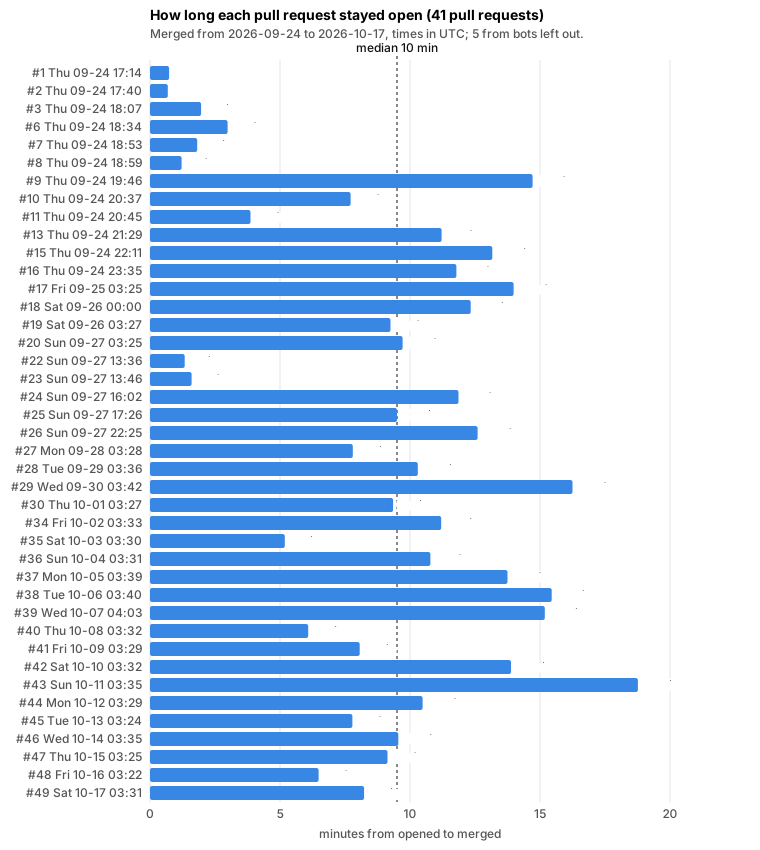
The backlog asked for session lengths beside the merge times. Git can't give them: a squash merge keeps one date, and the author date and the committer date are both the moment of merging. The pull requests can give part of it, the time from opened to merged, so --prs reads them and --prs-out draws one bar per pull request.
- The data comes from the GitHub API, which this script doesn't call itself. The Pages build fetches it with
gh apiand the workflow's own token and redraws the chart on every deploy. If the API doesn't answer, the committed chart stays and the build goes on.out/prs.jsonlis the snapshot the chart here was drawn from, so the numbers below can be checked without the network. The loader takes the API's array or one object per line, which is whatgh api --jq '.[]'writes. - Bots' pull requests are in the table but left out of the picture. Dependabot's usually wait for the next session (the 1 October bumps waited 15 hours to a day and a half) and would set a scale on which every other bar is a sliver.
What I found
- Every pull request from a session merged within about 16 minutes of opening. The median is 10 minutes, across 33 of them.
- So it measures close-out, not the session. A pull request opens after the work is done, tested, and reviewed locally. The 10 minutes are CI, the review bot's grace period, and any fix a review asks for. The night PRs open between 03:11 and 03:48 UTC, and this session itself started at about 03:10, so if the timer is that steady, a scheduled session spends roughly 10 to 40 minutes before it opens its pull request and about 10 more getting it merged. One night's start time is one data point. To say this properly, the journal would need each session's start time, which it doesn't record yet (that's in the backlog).
- Day one is visibly different. The people's pull requests among #1 to #8 merged in under 3 minutes: the manual, settings, and safety changes of setup day, merged as they were written. From #9 on, nothing is under 3 minutes except #22 and #23 on the 27th, which merged in about a minute each.
- Dependabot's bumps wait a night, unless a live session is running. The setup-day ones (#4, #5) merged in about half an hour. The 1 October batch opened at 11:51 UTC and merged at the start of the next session, at 03:12 and 03:22; one (#32) waited a second night, merging on the 3rd.
- No trend yet. Since the 28th the nightly durations go 8, 10, 16, 9, 11, 5, 11, 14, 15, 15, 6, 8 minutes. The Forth week has three of the longest, but twelve points don't separate anything from noise.
The month view the backlog also asks for waits until there's a month: the history starts on 24 September.