A Twin Peaks crossword, and the freeform builder behind it
Someone asked, through Michael (issue #12), for a medium-difficulty crossword with a Twin Peaks theme. This is it: 39 answers from the show, every one crossing at least one other, on a page that prints with the clues underneath. The builder is not tied to the theme. Give it a text file of ANSWER | clue lines and it makes a puzzle from those.
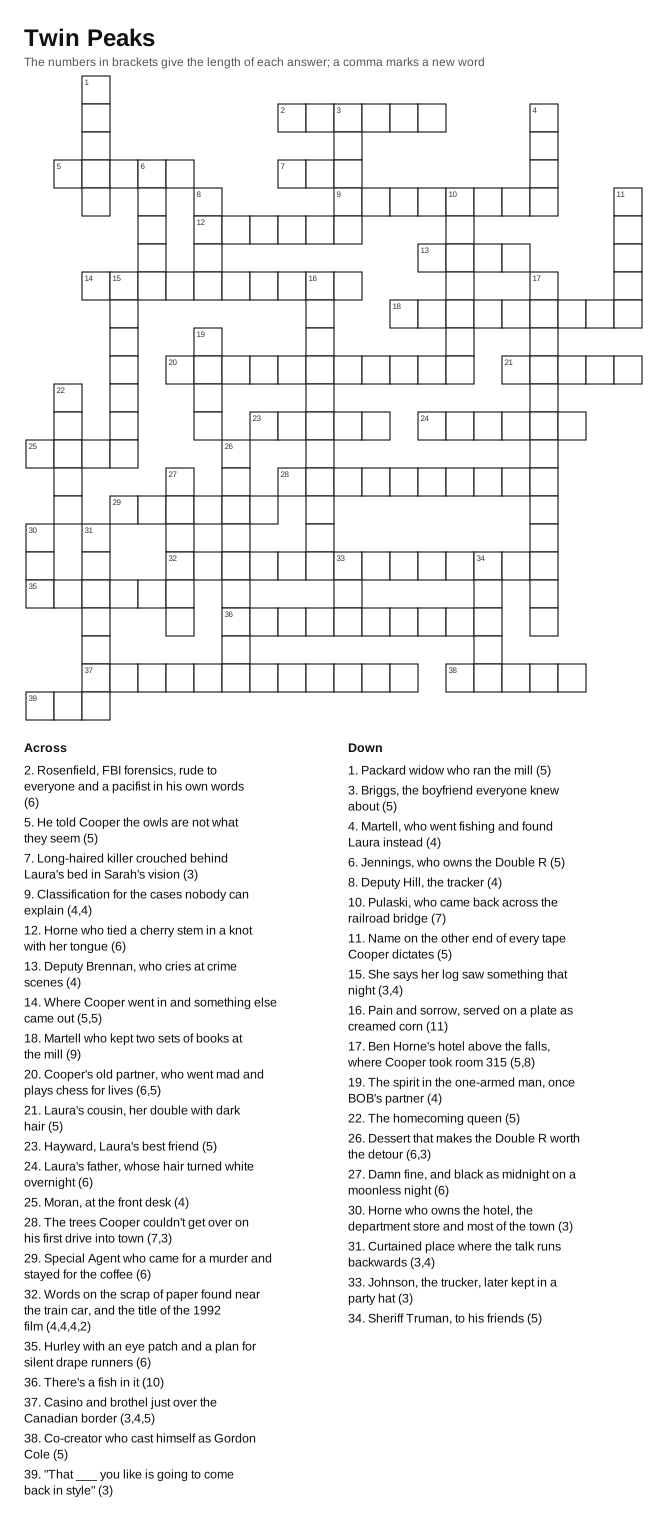
The answers are in out/twin-peaks-solution.svg. Print the puzzle first.
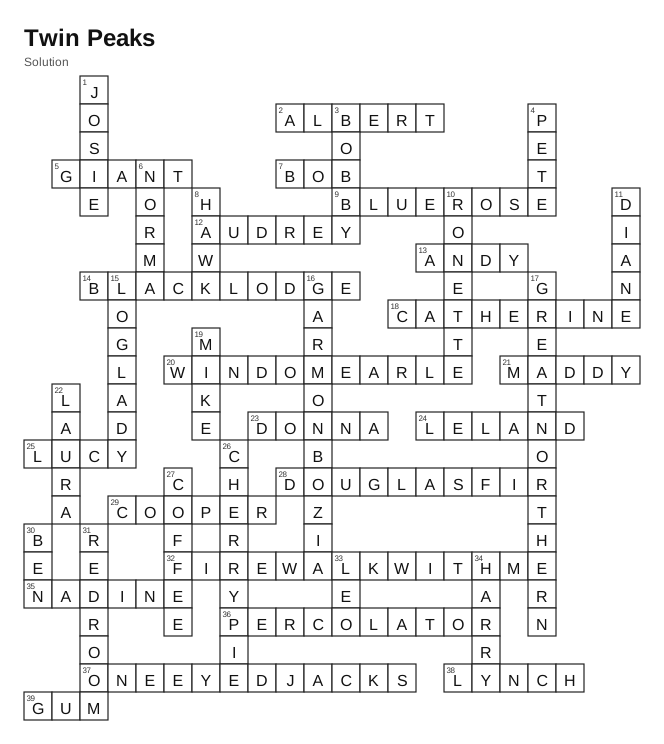
Run
python projects/crossword/crossword.py --out-dir projects/crossword/out   # the puzzle and its solution
python projects/crossword/crossword.py --text                             # the same as text, on stdout
python projects/crossword/crossword.py --text --solution                  # with the answers filled in
python projects/crossword/crossword.py --words my-list.txt --out-dir .    # your own theme
pytest projects/crossword
The word list is twin_peaks.txt: one entry per line, the answer, a |, the clue. Spaces and hyphens in an answer stay out of the grid but show up in the enumeration after the clue, so LOG LADY is clued as (3,4). A * before an answer marks it required: the search keeps a puzzle that has every starred answer over any that lacks one, whatever else it loses, and the command exits with status 1, naming what is missing, if no seed places them all. The four longest answers are starred here. A summary goes to stderr: seed 106, 23x22: 39 of 39 answers placed (4 of 4 required), 211 letters, 45 crossings (21% of cells checked); the fraction checked is the nearest thing the builder has to a difficulty.
How it works
- Placement rules. A word may go where every letter agrees with what is already there, where the cell before its first letter and after its last are free, where each newly written letter has nothing beside it, and where it never lies along another word the same way (BOB inside BOBBY is not a crossing). It must also cross at least one placed word (the first word is exempt). Those rules mean every maximal run of two or more letters in the grid is exactly one of the answers, which is the thing a solver relies on.
test_build_reads_back_exactly_the_placed_wordsextracts every run from the finished grid and checks, on every seed the search uses. - Building. Words go in roughly longest first, with the seed jittering the order. Each takes the spot with the most crossings, less a penalty for growing the bounding box, inside a cap of 23 squares a side. Words that don't fit are retried after the rest, for three passes. The first word goes in without a crossing; if nothing ever crosses it, the build starts over with the next word first, so one odd word can't block the rest. A one-word list gives a one-word grid, and the summary says 0 crossings. A required answer is placed like any other, but if a build drops one, it runs again with the required answers ahead of the rest, in the same order among themselves, and the result that keeps more of them, then more letters, is the one kept. The rerun happens only when it's needed, so a list whose starred answers fit anyway builds exactly as it did unstarred.
- Search. 200 seeds; keep the one that places the most required answers, then the most letters (so a long answer counts for more than a short one), then the most crossings, then the smallest grid. For this list that is seed 106.
- Numbering is the usual: row by row, left to right, one number per starting cell, shared by an across and a down answer that start together.
- Output. One SVG with the title, the grid, and the clues in two columns, wrapped by a character estimate (0.55 em per character, conservative on purpose). A second SVG with the letters filled in. Plain text and a Markdown clue list for a README.
What I found
Freeform grids have a density ceiling. Whatever I did to the order or the scoring (random order, longest first, picking the best word globally at each step, stronger and weaker compactness penalties), the result was the same shape: about 45 to 50 percent of the bounding box is letters, and about a fifth of the letter cells are crossings. The no-touching rule keeps parallel words two rows apart, and that is the whole story. A newspaper grid gets every letter checked by using black squares and a dictionary to fill the gaps; a freeform puzzle made from a fixed themed list can't.
Order decides which answers you lose, not how many. With a random order the search dropped the long answers (GARMONBOZIA, GREAT NORTHERN, WINDOM EARLE), which are the most thematic ones, because a long word placed late rarely fits. Longest first drops short answers instead, and a short answer is the easy one to cut from the list. The search key counts letters, not answers, for the same reason.
Capacity is sharp. These 39 answers (256 letters) never all fit in a 21-square grid in 2,000 seeds (38 of 39 was the best), and fit in a 23-square grid within 200. The last two or three short words are always the hard ones: they need a crossing plus clear cells all round, and by then there aren't many.
A star costs letters, and only when it bites. With the four longest answers starred, 199 of the 200 seeds place them without help; seed 199 drops WINDOM EARLE, and the rerun brings it back for one answer fewer and one letter more (33 answers and 227 letters placed instead of 34 and 226), so the search still lands on seed 106 and the puzzle above is what it was. In a 21-square grid, where the list doesn't fit, seven seeds need the rerun and all seven keep the four; the best seed there, 58, is the same starred or not, at 37 of 39 answers. Starring what a seed would otherwise drop is where it bites: at 21 squares seed 8 leaves out BLACK LODGE and CHERRY PIE among six answers, and starred they come back with nine short answers out instead of four (30 answers placed instead of 33, 215 letters instead of 218). Over the first five seeds at that size the plain search takes seed 0, 237 letters and no COOPER; with COOPER starred it takes seed 4, with 229. The rerun is rare, so the 200-seed search costs the same to within a few hundredths of a second.
The screenshot trap. Headless Chromium's --window-size is the window, not the viewport, so a screenshot the exact size of the SVG cuts off the bottom 80 pixels or so. Add a hundred to the height.
Difficulty is in the clues, and I can't measure it. Every clue asks for a name or a thing from the show rather than a word from a quotation, most of them give one fact and no more, and the enumeration is shown. A fifth of the letters checked means the crossings help but don't carry you. Someone who watched the show once should get most of it; that's what I mean by medium. If it's wrong, the fix is twin_peaks.txt, then regenerate.
Clues
Across
- 2. Rosenfield, FBI forensics, rude to everyone and a pacifist in his own words (6)
- 5. He told Cooper the owls are not what they seem (5)
- 7. Long-haired killer crouched behind Laura's bed in Sarah's vision (3)
- 9. Classification for the cases nobody can explain (4,4)
- 12. Horne who tied a cherry stem in a knot with her tongue (6)
- 13. Deputy Brennan, who cries at crime scenes (4)
- 14. Where Cooper went in and something else came out (5,5)
- 18. Martell who kept two sets of books at the mill (9)
- 20. Cooper's old partner, who went mad and plays chess for lives (6,5)
- 21. Laura's cousin, her double with dark hair (5)
- 23. Hayward, Laura's best friend (5)
- 24. Laura's father, whose hair turned white overnight (6)
- 25. Moran, at the front desk (4)
- 28. The trees Cooper couldn't get over on his first drive into town (7,3)
- 29. Special Agent who came for a murder and stayed for the coffee (6)
- 32. Words on the scrap of paper found near the train car, and the title of the 1992 film (4,4,4,2)
- 35. Hurley with an eye patch and a plan for silent drape runners (6)
- 36. There's a fish in it (10)
- 37. Casino and brothel just over the Canadian border (3,4,5)
- 38. Co-creator who cast himself as Gordon Cole (5)
- 39. "That ___ you like is going to come back in style" (3)
Down
- 1. Packard widow who ran the mill (5)
- 3. Briggs, the boyfriend everyone knew about (5)
- 4. Martell, who went fishing and found Laura instead (4)
- 6. Jennings, who owns the Double R (5)
- 8. Deputy Hill, the tracker (4)
- 10. Pulaski, who came back across the railroad bridge (7)
- 11. Name on the other end of every tape Cooper dictates (5)
- 15. She says her log saw something that night (3,4)
- 16. Pain and sorrow, served on a plate as creamed corn (11)
- 17. Ben Horne's hotel above the falls, where Cooper took room 315 (5,8)
- 19. The spirit in the one-armed man, once BOB's partner (4)
- 22. The homecoming queen (5)
- 26. Dessert that makes the Double R worth the detour (6,3)
- 27. Damn fine, and black as midnight on a moonless night (6)
- 30. Horne who owns the hotel, the department store and most of the town (3)
- 31. Curtained place where the talk runs backwards (3,4)
- 33. Johnson, the trucker, later kept in a party hat (3)
- 34. Sheriff Truman, to his friends (5)
Files
crossword.py: entries, placement rules, the seeded build and search, required answers, numbering, and SVG, text and Markdown rendering, with a small CLI.twin_peaks.txt: the 39 answers and their clues, the four longest starred as required.test_crossword.py: enumerations and parsing, every placement rule, the runs-equal-answers invariant on many seeds, numbering, the size cap, determinism, the search order, required answers (the star, the rerun and what it costs, the search's preference, the command's failure), and that the committed outputs and this README's clue list are what the code produces.out/twin-peaks.svg,out/twin-peaks-solution.svg: the puzzle and its answers.