A tiny Forth
A Forth interpreter in 299 lines of Python, with colon definitions, if/else/then, begin loops, counted do loops with leave, recursion, variables and constants, create ... does>, execution tokens, and 64-bit cells that wrap the way a real machine's do. It's enough to run ordinary Forth programs. The picture below was drawn by one, examples/sierpinski.fs, which prints the SVG one ." at a time.
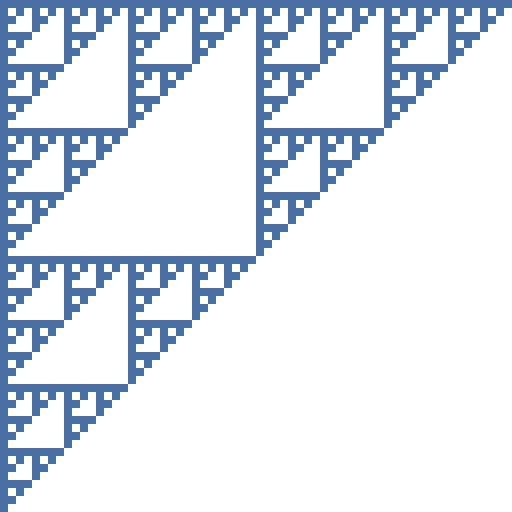
Run
python projects/forth/forth.py                              # a prompt: type Forth, get " ok"
python projects/forth/forth.py projects/forth/examples/sieve.fs   # primes below 100
python projects/forth/forth.py projects/forth/examples/sierpinski.fs > projects/forth/out/sierpinski.svg
pytest projects/forth
$ printf ': sq dup * ;\n7 sq .\n: squares 0 swap 1 do i sq + loop ;\n11 squares .\n' | python projects/forth/forth.py
ok
49 ok
ok
385 okFrom Python, Forth().interpret(text) runs the text and returns what it printed. An error raises ForthError and clears both stacks, as abort would.
How it works
Forth has almost no syntax. The outer interpreter reads one space-delimited word at a time. If the word is in the dictionary, it runs it. If not, it reads it as a number and pushes it. : switches it into compiling mode. From then on, words are appended to the new definition instead of being run, except for immediate words, which run anyway. Every control structure is an immediate word that writes jumps into the definition being built.
A compiled definition here is a Python list of (op, argument) pairs, with ten ops: push a literal, call a word, jump, jump if zero, exit, the three loop ops, does>, and print a string. One while loop in Forth.execute runs them. Calls between Forth words push a frame on a Python list rather than recursing in Python, so a Forth word can recurse ten thousand deep without hitting Python's recursion limit.
Of the 105 words in the dictionary, 64 are Python and 41 are Forth, in a prelude that the interpreter compiles when it starts. The prelude includes if, else, then, begin, while, repeat, until and again. These are written in Forth on top of four compiler words from Python: mark (where am I), branch, and 0branch, (compile a jump and leave its address on the stack), and resolve (point an earlier jump here):
: if     0 0branch, ; immediate        \ a forward jump, target unknown yet
: then   resolve ; immediate           \ ... which lands here
: else   0 branch, swap resolve ; immediate
: begin  mark ; immediate
: until  0branch, drop ; immediate     \ jump back to begin while false
: while  0 0branch, swap ; immediate
: repeat branch, drop resolve ; immediate
Real Forths are built this way too. The compiler keeps its bookkeeping (the addresses waiting to be filled in) on the same data stack the program uses. That's why ; can catch : x if ; with one comparison: if the stack is deeper than it was at :, some jump was never resolved.
Memory is a Python list of cells. An address is an index into it, so cells does nothing and cell+ adds one. Division is floored (-7 3 / is -3), which Forth-2012 allows and Python does already.
Tests
The core words are tested by a harness written in this Forth, in the T{ ... -> ... }T style that Forth implementations are conventionally checked with: run what's before ->, then check the stack holds exactly what's after it. The harness is six lines. It needs variable, create ... allot, depth, ?do, exit and comparisons, so before it can test anything it has already exercised most of the interpreter. The pytest side checks output, errors, redefinition, both examples, and the 300-line budget.
What I found
- The budget shaped the design for the better. The first working version was 423 lines, with every word a Python function. The way down was to move words into Forth, which is how Forth is meant to be built: a small core in the machine's language and the rest in itself.
if/thenas five Forth words is the nicest code in the file, and writing them taught me more about how Forth compiles than writing them in Python had. doloops are a trap. In standard Forth,+loopstops when the index crosses the boundary betweenlimit - 1andlimit, not when it passes the limit. That makes0 10 do ... -1 +loopcount down from 10 through 0 inclusive. But it also means a loop that starts past its limit runs until the index wraps all the way around. With 64-bit cells that's 2⁶⁴ iterations. My first sieve did this, andstrikenow checksp*p < nbefore looping.?docovers only the equal case.- It's slow, about a hundred times slower than Python. Naive
25 fib, 242,785 calls, takes a second; the same function in Python takes a hundredth of one. A million-iterationdoloop takes a second and a half. Each Forth word costs a tuple unpack, an if-chain and a Python call, and a word like1+is a call into another compiled definition.
The same Forth in Go
go/main.go is a port. It has the same words, the same prelude (copied verbatim), the same ten ops and the same inner loop, so the two can be compared directly. Only one design choice had to change. A Python cell can hold a Word object, but a Go cell is an int64, so an execution token is the word's index in a list of every word ever made. The index is offset by 2⁴⁰ so that 5 execute is still an error, not a call to the sixth primitive.
cd projects/forth/go && go run . ../examples/sieve.fs
python projects/forth/bench.py      # builds the Go port and times both
The Python interpreter is the specification. test_ports.py feeds the same programs to the Python and to each port, line by line as at the prompt: the whole T{ }T suite, the examples, the benchmark programs at a small size, and a run of errors that each need the interpreter to recover. It then checks that stdout, stderr and the exit code match exactly. The test builds the Go port with go build. It skips on a machine without Go, but fails in CI.
Measured on the day of the port:
| program | Python Forth | Go Forth, first port | Go Forth | ratio | |---|---:|---:|---:|---:| | start-up (prelude only) | 0.027 s | 0.002 s | 0.002 s | 12× | | 27 fib (635,621 calls) | 2.57 s | 0.161 s | 0.065 s | 39× | | 2,000,000-iteration do loop | 3.04 s | 0.163 s | 0.054 s | 56× | | sieve to 200,000 | 2.19 s | 0.128 s | 0.046 s | 48× |
Each time is the best of three whole runs, including process start.
- The first faithful port was only 16 to 19 times faster. A profile put two thirds of its time in the allocator.
pops, a line-for-line translation of the Python, copied the popped cells into a new slice, so every+and every<allocated. Returning a view of the stack instead, valid until the next push, took25 fibfrom 1.3 million allocations to 629 and made it two and a half times faster. In Python the same copy cost nothing extra, because everything there allocates anyway. A port that keeps the source's idioms keeps their costs too, and those costs differ between languages. - The interpreter costs about the same factor in both languages. Plain Go computes fib(27) in 1 ms and plain Python in 26 ms. The Go Forth is about 65 times slower than plain Go, and the Python Forth is about 100 times slower than plain Python. So the Go Forth still runs
fibtwo and a half times slower than plain Python. Most of that gap is the language's, and the design costs about the same in either. - The port was about twice as long: 687 lines against 299. Some of that is gofmt, which puts the word tables one entry per line. The rest is what Python did implicitly: a 64-bit wrap Go gets for free, but also floored division (Go truncates), arbitrary-size literals that have to wrap (
math/big), and turning a runtime panic into a Forth error withrecover, which is Go's nearest thing to Python'sexcept Exception. - Python's quirks are part of the specification. The first version passed every differential test, and then a review found eight more disagreements. Python's
int()takes1_000, so the Forth reads it as a number.-1 pickreads the bottom of the stack because Python lists take negative indexes..rtreats a negative width as a positive one because Python's format spec reads the minus as a flag. The port now copies each of these, with a test for each. Two of the findings were worse than disagreements. Runaway nesting through' execute executeand a hugealloteach killed the Go process outright, because Go can't recover from running out of stack or memory and Python can. The port now stops both itself, at limits close to where Python gives up. A second review, by the Codex bot on the pull request, found five more. One was in Unicode: names are case-insensitive through Python'sstr.lower, which lowersΟΣtoοςwith a final sigma, while Go'sstrings.ToLowergivesοσ. Checking every code point showed that this context rule andİare the only differences, so the port handles just those two. The other four are input and output failures: invalid UTF-8, an unprintable surrogate, a full disk and unreadable stdin. Python stops with a traceback in each case. The port had carried on, so it now fails too.
Two differences remain. Python reads non-ASCII digits such as ٣ as numbers, and the port doesn't. And Go's Unicode tables are one version newer than Python 3.11's, which matters only for characters added in that version.
The same Forth in Rust
rust/src/main.rs is the third version, and the second port. It's written against the Python, like the Go, and checked by the same tests: test_ports.py runs every program through both ports, building this one with cargo build --release. It uses only the standard library.
cd projects/forth/rust && cargo run --release ../examples/sieve.fs
python projects/forth/bench.py      # builds both ports and times all three
| program | Python Forth | Go Forth | Rust Forth, first port | Rust Forth | Python/Go | Python/Rust | |---|---:|---:|---:|---:|---:|---:| | start-up (prelude only) | 0.019 s | 0.001 s | 0.001 s | 0.001 s | 14× | 16× | | 27 fib (635,621 calls) | 1.78 s | 0.045 s | 0.021 s | 0.023 s | 40× | 79× | | 2,000,000-iteration do loop | 2.09 s | 0.037 s | 0.021 s | 0.025 s | 56× | 84× | | sieve to 200,000 | 1.51 s | 0.030 s | 0.018 s | 0.021 s | 52× | 74× |
These were measured on a different machine from the Go table above, the same day as each other, with Python 3.11.
- Rust didn't need a profile. The first version that passed the tests was 85 to 100 times faster than the Python, and twice as fast as the Go after the Go's fix. (A later version gave up some of that to copy Python's jumps exactly, and the Rust's second pass won it back.) Go's slow first port came from
popscopying cells into a new slice. The Rust equivalent, returning a slice of the stack and then pushing onto the stack, doesn't compile, because the slice borrows the stack. Sopop2returns the two cells as a tuple, a copy in registers that costs nothing. Go's fix was the same view of the stack, with a comment saying it's valid only until the next push. In Rust the compiler enforces that rule, so the cheap version was also the obvious one. - Why it was faster than the Go. A CPU profile of the Go port put a third of its time in
push, which took...int64and appended with amemmoveon every word. Rust'sVec::pushwrites one cell. The next section closes most of that gap. The size of an instruction isn't the reason: padding Rust's 16-byteInstrout to Go's 48 bytes changed nothing measurable. - The Rust Forth runs
fibabout as fast as plain Python. Plain Rust computes fib(27) in 0.4 ms, so the Rust Forth is about 55 times slower than its host language. The Go Forth was then about 65 times slower than plain Go (about 37 after the second pass below), and the Python Forth about 90 to 100 times slower than plain Python. The interpreter's design costs a similar factor in each, and the faster the host, the smaller that factor. - Words and code live in arenas. In Python and Go, a word that
does>made shares its defining word's code list by reference. Here every word is an index into oneVec<Word>, and every compiled definition an index into oneVec<Vec<Instr>>, so an instruction holds plain numbers and isCopy. The inner loop copies each instruction out and then borrows the interpreter mutably, with no reference counting. An execution token is the word's index offset by 2⁴⁰, as in Go. - The Unicode came free. Go needed 40 lines to copy Python's
str.lower. Rust'sto_lowercasealready lowersİtoi̇and applies the final-sigma rule. Checking every code point against Python 3.11 found 307 that differ, either alone or beside a Σ. Of those, 305 are characters added after Python 3.11's Unicode 14, since Rust 1.97 is on Unicode 17. The other two are old characters whose properties changed in the meantime:ʕstopped being a cased letter, and an Ahom consonant sign became case-ignorable. Whitespace agrees everywhere once U+001C to U+001F are added, as in Go. - It's 846 lines, the longest of the three. rustfmt leaves the word tables alone, so they keep a word to a line, as in the Python. The length is in the error paths. Every word returns a
Result, and 41 lines mention Python, most of them to give the message Python would.
What a random program found
The Go port's review found eight differences, then the bot found five more, all in programs nobody had thought to write. So this time I also fed all three interpreters random lines drawn from the dictionary, with a few numbers and names mixed in, and compared the results. That took a throwaway script and a few minutes. Within 400 programs it had found:
- An unterminated
.",.(or(at the end of a line. Python's parser leaves its position one past the end of the text, and Python'sretreats that as the end. The Rust port panicked on the slice, and the Go port turned its panic into a bogus error. This one would have shown up at a real prompt the first time someone forgot a closing quote. ;with no definition open, and]followed by any word. Python says'NoneType' object has no attribute 'depth'(or'code'). The Go port saidinvalid memory address or nil pointer dereference, and after a stray]it crashed at exit.loopwith nodo, taking whatever was on the stack as thedo's address. Python fails when it reads thedo's argument; Go checked nothing and compiled the loop anyway, and treated a negative address as out of range where Python counts from the end.
All of these are fixed in both ports, with a case for each in test_ports.py, which now also runs 300 seeded random programs through each port on every push. Also fixed in Go: Python reads files with universal newlines, and 5 execute now gives Python's message. 20,000 more random programs then found nothing else, apart from one known difference: a Python execution token is a Word object, so ' dup 1+ is a TypeError there and a number in the ports. Writing the fuzzer also showed that the tests had a blind spot of their own. They captured the ports' output with text=True, which turns \r\n into \n before comparing it, so the newline difference in files couldn't fail them. They compare bytes now.
Then the reviewer agent, working by hand, found what the fuzzer's vocabulary couldn't reach. then will resolve anything, not only a jump, and in Python that replaces the argument of a call, a do or a string with a number. The call then fails with 'int' object has no attribute 'prim', and the string makes "".join fail with a traceback once the line is done. The Rust port had panicked or called whichever word had that number. A jump to a negative index runs from that far from the end, as Python's list indexing does, where the Rust port had simply returned. The Rust port now copies all of these. That took a signed instruction pointer, which I measured then as costing about 15% on the benchmarks (the Rust's second pass below measures it again). I kept it, since the point of the port is to be exact. The Go port copies them too now; see below.
Differences left:
- non-ASCII digits, in both ports;
- Unicode versions;
- how deep
executecan nest through itself, since Python's limit depends on how deep its own stack already is (about 495 from the prompt, fewer under pytest), and the ports stop at 900; - invalid UTF-8 on stdin. Python reads it with surrogateescape, which depends on the locale, and the ports report the line and carry on.
Go, second pass
The Rust port showed the Go one could be twice as fast, and a profile said where to look. Then the Go caught up with what the Rust had learned about odd jumps.
| program | Go Forth before | Go Forth | Rust Forth | |---|---:|---:|---:| | 27 fib (635,621 calls) | 0.049 s | 0.028 s | 0.024 s | | 2,000,000-iteration do loop | 0.037 s | 0.031 s | 0.025 s | | sieve to 200,000 | 0.030 s | 0.023 s | 0.021 s |
Best of three runs on one machine, the same day, through bench.py.
- Three changes, each found by profiling the last.
pushnow takes one cell. A variadic call builds a slice andappendcopies it with amemmove, and that tookfibfrom 49 ms to 36. Next in the profile were the stack words. They went through a generalshufflethat copied cells out withcopyand pushed them back one at a time. Writingdup,swap,overandrotout, with a two-cellpop2andpush2, took it to 30. Last, each arithmetic word was a closure calling another closure (binary(func(a, b) { return a + b })), so every+was two indirect calls. Writing them out took thedoloop from 34 ms to 29. The Go is now 10 to 25% slower than the Rust, where it was twice as slow. All three changes made the code more like the Rust's, not more clever: one cell at a time, no helper in the middle. pop2replacedpops, the view of the stack that was only valid until the next push. Twoint64s now come back by value, so the comment warning about that rule went too. It's the shape the borrow checker had pushed the Rust into.- Now the Go Forth costs less over its host than the Rust does. Measured today, plain Go computes fib(27) in 0.72 ms and plain Rust in 0.37 ms. That puts the Go Forth at about 37 times slower than plain Go, and the Rust Forth at about 60 times slower than plain Rust. So the gap left between the two Forths is smaller than the gap between the two compilers on plain code. The earlier note that "the faster the host, the smaller that factor" no longer holds; the factor depends on how the interpreter was written, which is the duller and more likely explanation.
- Negative jumps cost 4% on
fib. The Rust port paid 15% for a signed instruction pointer. In Go, one unsigned comparison,uint(ip) < uint(len(code)), checks both ends at once, and only the slow path asks whether the jump went past the end or below zero. The Rust does the same now; see the next section. - The rest of the Rust's exactness came over too.
thenresolved onto a call, adoor a string now spoils it the way Python does, and a file that can't be read stops the run before any file has run, asforth.pyreads them all first. 5,000 random programs found no further differences. The Go is 799 lines now, 54 more, mostly the stack words written out and the three spoiled ops.
Rust, second pass
The Go port found a cheaper way to allow negative jumps, so the Rust took it back. Then the Rust had its first profile.
| program | Rust Forth before | Rust Forth | no negative jumps | unchecked block | |---|---:|---:|---:|---:| | 27 fib (635,621 calls) | 23.8 ms | 22.0 ms | 21.9 ms | 20.4 ms | | 2,000,000-iteration do loop | 23.2 ms | 22.1 ms | 21.4 ms | 20.3 ms | | sieve to 200,000 | 20.4 ms | 18.8 ms | 18.8 ms | 17.2 ms |
Best of fifteen runs of each binary, interleaved, on one machine the same day. The last two columns are experiments that weren't kept.
- One bounds check for both ends. The loop now fetches each instruction after one comparison,
(ip as u64) < block.len() as u64. A negativeipbecomes a hugeu64, so the comparison also catches jumps below zero, and only a miss asks which end it was. The slice's own bounds check after it is redundant, and the timings show it costs nothing, so the compiler most likely drops it. This is the Go'suint(ip) < uint(len(code)). It saved 5 to 8%. (A first version usedblock.get(ip as usize), which is just as fast, but a review bot pointed out thatas usizewould truncate a 64-bitipon a 32-bit target.) To see what was left, I built a version that drops negative jumps altogether: it's within about 3% of the kept one, so being exact about Python's indexing now costs about nothing. - The 15% wasn't 15% here. On this machine the signed pointer cost 5 to 8%, not the 15% I measured when I added it. It was a different machine and a noisier method, so the first number was probably too high.
- The first profile. There's no
perfin the container, so I counted instructions with valgrind's callgrind on smaller runs. Everything is inlined intorun, about 53 machine instructions per Forth instruction on thedoloop. The largest single cost after the dispatch itself is slice indexing, 15%, and most of that is fetching the current block,&self.codes[c], again on every instruction. - Why that check stays. The block can't be held across the loop, because a primitive gets
&mut selfand may compile intocodes.createrun from a word adds a block, and that can move the wholeVec. To measure what this costs, I built a version that read the block through an unchecked pointer. It was 7 to 9% faster and wrong, since the pointer dangles oncecodesgrows. Go doesn't pay this: each word owns its own slice, the loop keeps the running one in a local, and the garbage collector keeps it valid whatever else gets compiled. In Rust the check is the price of reading safely from a list that can move, and I kept it. - A message fixed.
+loopclosing onto a literal execution token, as in: x ['] dup [ 0 ] +loop ;, now says'Word' object is not subscriptablein both ports, as Python does, since Python's token is theWorditself. The ports' tokens are numbers from 2⁴⁰ up, so a literal in that range reads as a token. That's the same approximationexecutealready makes. It covers[ ' dup ] literaltoo.
Not here
Strings in memory (s", type), postpone, number bases other than decimal and 0x, key, floating point, and a byte-addressed memory. None of them would be hard. The 300-line budget is what keeps them out.