Look-and-say: Conway's constant, from the sequence up
Start with 1 and read each term aloud to get the next: one 1 is 11, two 1s is 21, one 2 one 1 is 1211, then 111221, 312211, and on. The lengths grow by about 30% a term, and John Conway proved the growth factor tends to a definite number, λ = 1.3035772690..., the only positive real root of a polynomial of degree 71. The backlog asked how many terms it takes for the ratio of successive lengths to get six digits of it. The answer is 80, which is too far to reach by building the strings (term 80 has 2.5 billion digits), so the project goes the way Conway did: it splits the terms into "elements" that evolve independently and counts those instead. It finds the elements from the sequence itself rather than from a table, and they come out as Conway's 92.
A second pass puts Conway's names on them and asks how common each one is in a late term: the long-run share of hydrogen, of uranium, and of everything in between. A third checks Conway's Cosmological Theorem by brute force: every seed, not just "1", ends up made of these elements, and the slowest short seed takes 24 days, though a longer one with a run of twenty-two 1s takes 25.
Run
python projects/lookandsay/lookandsay.py                                          # elements, polynomial, constant, and the digits table
python projects/lookandsay/lookandsay.py --out projects/lookandsay/out/convergence.svg  # and the chart
python projects/lookandsay/lookandsay.py --abundance-out projects/lookandsay/out/abundance.svg  # the abundance chart
python projects/lookandsay/lookandsay.py --cosmos 9                               # every seed of 1s, 2s and 3s up to 9 digits
pytest projects/lookandsay
The whole run takes about six-tenths of a second; --cosmos 9 adds twenty seconds and --cosmos 10 a minute.
How it works
- When does a string split? Reading
xyaloud gives the reading ofxfollowed by the reading ofyexactly when the last digit ofxdiffers from the first digit ofy; otherwise the two runs merge. Reading aloud never changes a string's last digit (the last run is still read as "count, that digit"), soxandystay separate forever exactly when the last digit ofxnever turns up as the first digit ofy,yread once,yread twice, and so on. - The first digits, exactly. That's an infinite condition, but it can be checked in finite time. Follow only a prefix of
y's descendants: reading a prefix aloud gets every run right except maybe the last, which may have been cut short, so dropping the final count-digit pair leaves a true prefix of the next string. Cut it to 16 characters and repeat. Each prefix is a function of the one before, so the first time one repeats, the sequence of leading digits is periodic from there on and the set of them is complete. For every suffix of every element this takes at most 18 steps, and a cap of 8 or 32 gives the same sets, which a test checks. - The elements. Split each string at every point that passes, recurse on the pieces, and follow what each piece becomes. From "1", 99 distinct pieces turn up. Seven of them are just the first seven terms, which never come back (1, 11, 21, 1211, 111221, 312211, 13112221). The eighth term, 1113213211, is the first to split: into 11132 and 13211, hafnium and tin in Conway's naming. The other 92 each reappear among their own descendants, and they are exactly Conway's 92 elements, from hydrogen (22, which reads as itself) to uranium (3), the longest being 42 digits. The count, the longest, and every element breaking into elements are tested; so is the claim that the splits hold, by evolving a split term for ten steps both whole and in pieces.
- Counting instead of building. Each element becomes a fixed list of elements, so a term is a vector of 92 counts (plus the seven genesis strings at the start) and one step is a matrix multiplication. The counted lengths match real strings for the first 40 terms, and the 50th is 894,810 digits, as it should be. A thousand terms, with exact integers of a hundred-plus digits, takes a fraction of a second.
- The polynomial. The characteristic polynomial of the 92×92 decay matrix is computed exactly: by Hessenberg reduction modulo large primes, enough of them to cover a proven bound on the coefficients (Hadamard's inequality on the principal minors), glued together by the Chinese remainder theorem. It factors as x¹⁸ (x − 1)² (x + 1) times a degree-71 polynomial, which is Conway's shape; the degree-71 factor is his famous polynomial, and a test checks the whole factorization. Newton's method on that factor gives
λ = 1.30357726903429639125709911215255189073070250465940...
and length(1001) / length(1000) agrees with it to all 50 places. That's two independent routes to the same number, one through exact counting and one through the algebra, meeting at the fiftieth digit.
What I found
How long the ratio length(n+1) / length(n) takes to get its first d digits right, and keep them (cut off, not rounded, so six digits means 1.30357):
 digits   from term
    2        28
    3        28
    4        47
    5        70
    6        80
    7       103
    8       121
   10       178
   12       196
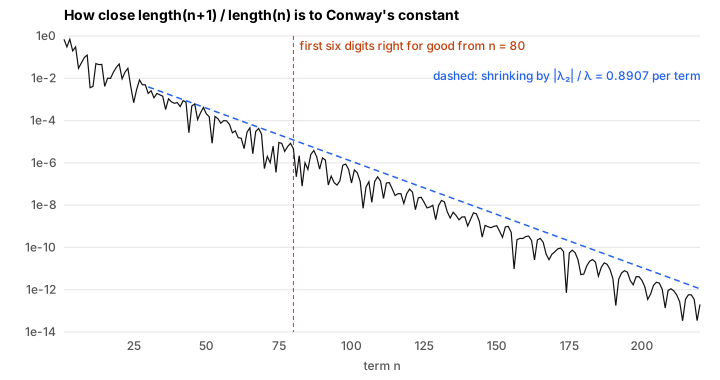
So six digits takes 80 terms, and it's a slow crawl: roughly one more digit every 20 terms. The reason is the next-largest root of the degree-71 polynomial, a complex pair at −0.98797 ± 0.61001i, of modulus 1.16112. The error in the ratio shrinks like (1.16112 / 1.30358)ⁿ = 0.8907ⁿ, which is the dashed line in the chart: a factor of ten every 20 terms. Because the second root is complex, the error doesn't just shrink but swings, and the ratio overshoots and undershoots the constant as it closes in. That's the jaggedness, and it is why "for good" matters: the ratio at term 44 already has four digits, briefly, and loses them again.
The six-digit mark shows it well. The ratio first has six digits right at term 66, loses them at once, gets them back at 70, keeps them through 72, loses them at 73, and flickers (right at 74, 77 and 78, wrong at 75, 76 and 79) before settling at 80.
Names and abundances
- Which string is which element. Conway numbered his elements from hydrogen (22) to uranium (3) so that each one's decay includes the element numbered one below it. The code looks for every ordering with that property, by depth-first search, and there are exactly four. All four agree from uranium down to tantalum (73). Below that, one goes its own way all the rest of the way to hydrogen, and the other three differ only between holmium (67) and scandium (21). One fact from Conway's table, that tin is 13211, picks out his ordering, and a test checks ten more of his entries against it (eight, really: uranium and hydrogen are where the search starts and ends). So the names are "found" only up to that one fact, plus the periodic table's symbols, which are typed in.
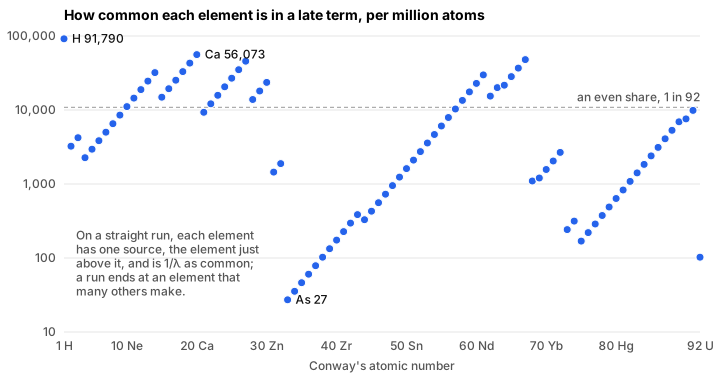
- Abundances. A term is a vector of element counts, and one step multiplies it by the decay matrix, so in the long run the counts line up with the matrix's left eigenvector for λ, its Perron vector. The code solves for it directly, by Gaussian elimination in 60-digit decimals, and separately counts the atoms in term 1,000 exactly. The two agree to 49 significant digits for every element, as the second eigenvalue says they should (0.8907¹⁰⁰⁰ is about 10⁻⁵⁰). Hydrogen comes out at 91,790.383 atoms per million and arsenic at 27.246, Conway's figures.
 most common        per million     least common     per million
 H  22               91,790.383      Br 3113112211322112        46.300
 Ca 12               56,072.543      Se 13211321222113222112    35.518
 Ho 1321132          47,987.529      As 1113122113121132...     27.246
The average atom is 7.674 digits long, so a late term of length L is made of about L / 7.674 atoms.
What the abundance chart shows
The dots don't scatter; they climb in straight lines. The reason is short. In the long run, λ times an element's share is the sum of the shares of whatever decays into it. Seventy-five of the 92 elements have exactly one source, which makes them once, and for 74 of those the source is the element one above in Conway's numbering. For those, λ·a(e) = a(parent): each is exactly 1/λ as common as the element above it, a straight line of slope log λ on a log scale. A run ends at one of the 17 elements that several others make, and the line jumps there. Calcium (12) has thirteen sources and hydrogen seven (one of them hydrogen itself), which is why they're the most common. The longest run is seventeen elements, ruthenium (44) up to neodymium (60), each 1.3036 times the last. Arsenic is the bottom of a run of ten that starts from technetium, which has only two sources and isn't common itself. The one exception to the rule is uranium: its only source is yttrium, element 39, so it sits apart from its neighbours, 96 times rarer than the protactinium it decays into.
The Cosmological Theorem
Conway's theorem says that any string at all, not only "1", eventually splits into his 92 common elements plus a few "transuranic" ones that need digits bigger than 3. The usual statement adds a bound: 24 days. This pass tests both by brute force.
- The transuranic elements, found. The same search that found the 92 from "1", run from the seeds 4, 5, ..., 9, finds two more elements per digit and no others: Conway's plutonium,
31221132221222112112322211n, and neptunium,1311222113321132211221121332211n, where n is the digit. A test checks all of them against his strings. - And a seventh pair. Digit 0 needs them too. A run of ten or more is read aloud as "10", "11", and so on, so
1111111111becomes101and a zero appears from a seed of 1s. The search from seed 0 finds plutonium and neptunium ending in 0, and without them1111111111never finishes decaying. Statements of the theorem I've seen talk about digits 4 and up; zero behaves the same way. - The day. For each seed, follow its pieces day by day (exactly, as the lengths were counted) until every piece is an element. Elements only ever make elements, so from then on it stays decayed. Every seed of 1s, 2s and 3s up to ten digits does, all 88,572 of them, and so does every seed of digits 0 to 9 up to four digits.
The slowest seed of each length, and how many days it takes:
 length   day   slowest seed
    1       7   1               (the seven terms before 1113213211)
    2       6   11, 31
    3      16   211
    4      19   1111, 2222, 3333
    5      19   13 seeds
    6      19   51 seeds
    7      20   2113332
    8      23   33322112, 33322113
    9      24   333222112, 333222113
   10      24   1333222112 and 3 more
So among short seeds, 24 days it is, reached first by two nine-digit seeds, and nothing up to ten digits takes 25. The slow seeds of lengths 8 and 9 are one chain: 333222112 reads aloud as 33322112, the 23-day seed, which reads as 33222112, and so on. Of the 19,683 nine-digit seeds, 2,355 take exactly 19 days and only 54 take longer.
But 24 can be beaten. My first draft of this section said the chain can't go back another day, because 333222112 has odd length and a reading aloud always has even length. That's only true while every count is one digit. A run of twenty-two 1s is read "221", so
333 222 1111111111111111111111 2 (29 digits)reads aloud as 33 32 221 12 = 333222112, and takes 25 days. Two 38-digit strings, one with a run of thirty-two 2s and one starting with a run of thirty-three 3s, read aloud as 333222112 too, and the same three with a final 3, plus a 66-digit one (thirty-three 3s, twenty-two 2s, eleven 3s), read as 333222113. All seven take 25 days. None of them is in turn the reading of anything under 200 digits, so the search stopped there. So the 24-day bound, as far as this search reaches, belongs to strings with no run of ten or more. Allow a long run in the seed and one more day is possible. I'd guess the usual statement of the theorem assumes this without saying so, but I haven't seen Conway's paper to check.
None of this is a proof. Brute force over short seeds can't rule out a long seed that takes 26 days; the theorem's proofs handle every length at once, which is a different kind of argument. What it shows is that 24 is reached, by a seed of only nine digits, and that it isn't the last word once runs of ten are allowed.
Notes
- The first-digit argument is the only piece of Conway's theory the code needs, and it is small enough to prove in a paragraph (above).
- The polynomial's roots other than λ come from the Durand-Kerner iteration in floating point, and the test checks each one's residual. The second root's modulus is quoted to five places, which is what that check supports. λ itself is polished separately with Newton's method in 60-digit decimals.
- I didn't prove the degree-71 factor irreducible. It's known to be, and nothing here depends on it.