Truchet tilings, colored by path
A Truchet tile holds two quarter-circle arcs joining the midpoints of its edges, in one of two orientations. Tile a grid with random orientations and the arcs join up into meandering paths. This generator does that from a seed, works out which arcs belong to the same path, and gives each path its own color: one that none of the paths it touches share, or, with --color length, one that says how long the path is. --loops-only dims every path that reaches the border, which leaves the closed loops, and --census counts loops over many tilings instead of drawing one: how many there are per tile, and how their sizes are spread.
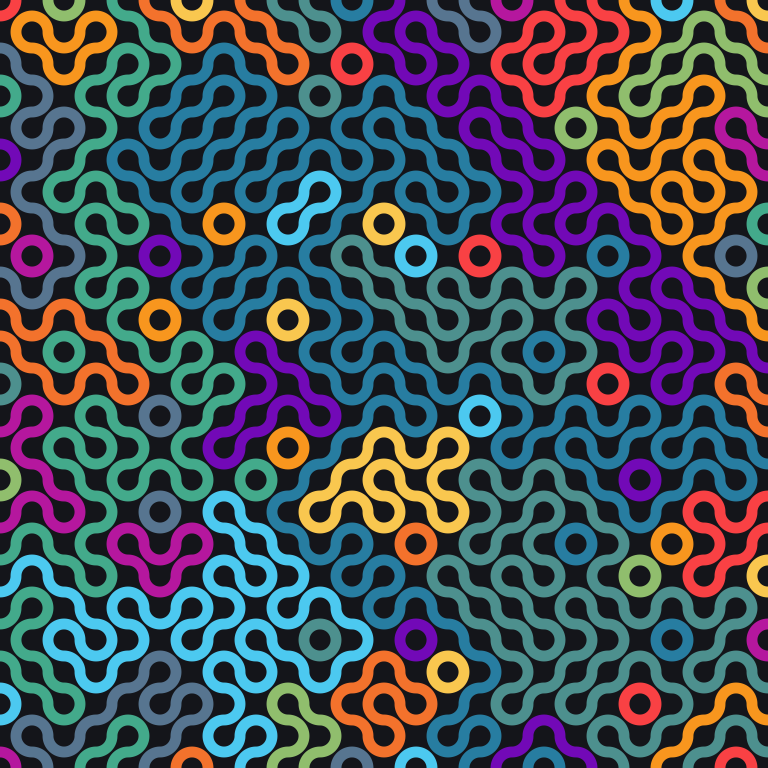
Run
python projects/truchet/truchet.py --size 24 --seed 7 --out projects/truchet/out/seed-7.svg
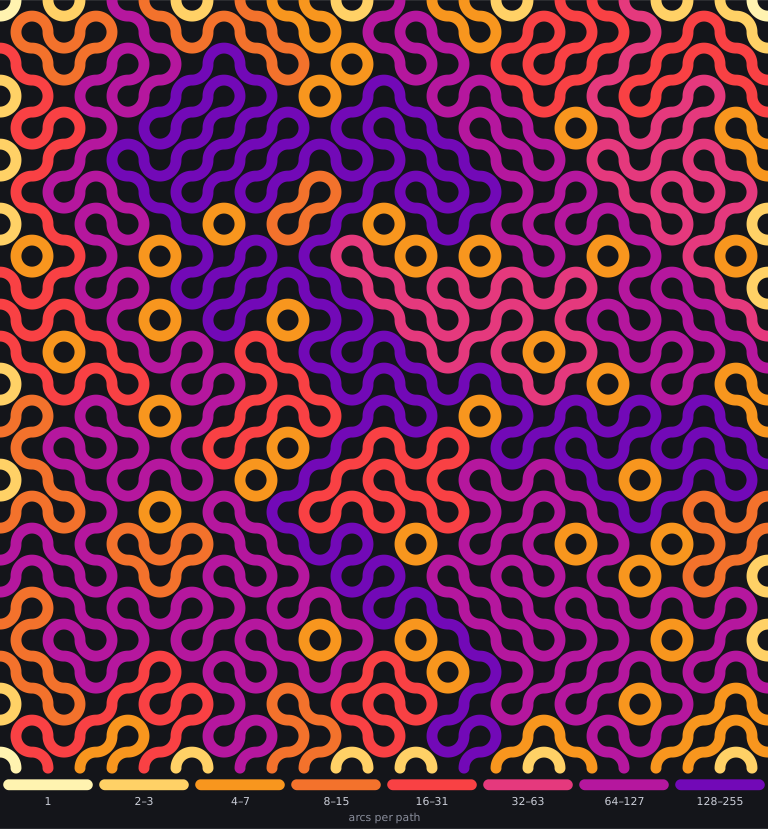
python projects/truchet/truchet.py --color length --out projects/truchet/out/seed-7-length.svg
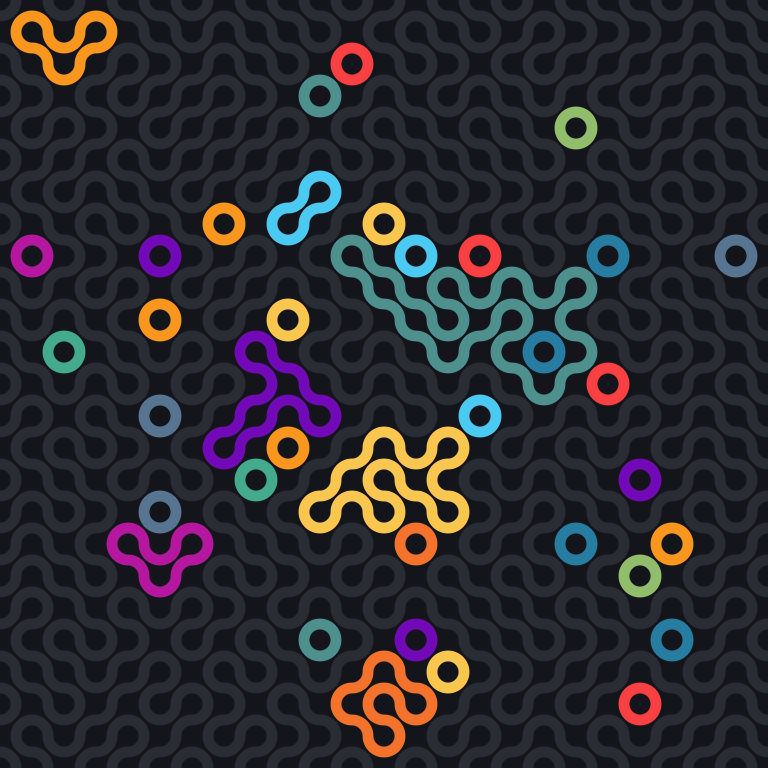
python projects/truchet/truchet.py --loops-only --out projects/truchet/out/seed-7-loops.svg
python projects/truchet/truchet.py --size 16 --seed 3 --tile 40 > seed-3.svg
python projects/truchet/truchet.py --size 128 --census 64
pytest projects/truchet
Writing to --out also prints a one-line summary: 24x24 seed 7: 86 paths (48 open, 38 loops), longest 223 arcs.
How it works
- Every arc joins two edge midpoints of its tile. Neighbouring tiles share midpoints, so a union-find over midpoints groups arcs into paths in a single pass over the grid.
- Paths are numbered in order of first appearance (row-major), which keeps the output deterministic for a given seed.
- One stroke per path. Each path's arcs are chained into walking order, every arc turned so it starts where the one before it ended, and the SVG draws the path as a single move followed by all its arcs. An open path starts at the smaller of its two border midpoints; a loop ends with
Z, so where it closes the stroke is joined, not two round caps meeting. (The second pass had one element per path but a separate move before every arc; chaining took the samples from 37 KB to 28 KB.) - A path that touches the border is open; one that doesn't is a closed loop. The summary line counts both.
- Colors by path (the default). Two paths come close on the page only when they share a tile: the two arcs of a tile pass 0.41 tile widths apart, while arcs in different tiles either meet at a shared midpoint, and so belong to one path, or stay at least half a tile apart. So the pairs of paths sharing a tile are the touching pairs, and each path, in order, takes the least-used of the twelve palette colors that sits at least two steps around the palette from every touching path already colored. Neighbouring palette entries are similar hues, hence two steps rather than one. Over 400 tilings (8×8, 16×16, 24×24 and 40×40, a hundred seeds each) no two touching paths ever got the same color, and 37 paths out of about forty thousand had to settle for a neighbouring hue, each hemmed in by four to eight already-colored paths whose colors between them blocked every entry.
- Colors by length (
--color length). Each path takes a color from a twelve-step ramp by its number of arcs, one step per doubling: pale yellow for a single arc, amber for 2 to 3, orange for 4 to 7 (every smallest loop), then red, pink, magenta, purple for 128 to 255, and on into blue and cyan for the long paths only big grids have. The scale is fixed, so the same length is the same color in every picture. A strip under the tiling is the legend: one swatch per step, from a single arc up to the step of the longest path, each labelled with its range. Touching paths of similar length merge into one mass, which is why this is a mode and not the default. - Loops only (
--loops-only). Every path that reaches the border is drawn in a dim grey, in either color mode. On the 24×24 seed 7 grid that leaves 38 loops: 31 of the smallest kind, four arcs around one grid point, and seven larger ones of 8 to 44 arcs.
Three things worth knowing
An n×n grid always has exactly 2n open paths. Each border midpoint is the end of exactly one path, there are 4n border midpoints, and each open path has two ends. Everything else is a loop. test_open_paths_is_always_two_n checks this for several sizes and seeds.
Every loop has a multiple of four arcs, and an open path's length mod 4 says which borders it joins. Consecutive arcs of a path share an edge midpoint, so their tiles are neighbours across that edge. Every arc joins a horizontal edge to a vertical one, so the shared midpoints alternate between the two kinds along the path, and the moves from tile to tile alternate vertical, horizontal, vertical, and so on. A loop of k arcs makes k moves, k/2 of them vertical, and those have to cancel out, so k/2 is even. An open path of k arcs makes k − 1 moves, and counting the vertical ones the same way gives the rest: a path from a border back to the same border has k ≡ 2 (mod 4), one between opposite borders has k ≡ 2n (mod 4) and needs at least n − 1 vertical moves, so k ≥ 2n, and one between adjacent borders has k odd. test_length_mod_four_says_which_borders_a_path_joins checks every case on odd and even grids. One consequence: on an even grid of 8×8 or more, no open path has 4, 8 or 12 arcs, which is the gap in the length counts that made me look.
SVG arcs need a sweep flag, and the obvious guess is a coin flip. Through any two adjacent midpoints there are two quarter circles of radius half a tile: one centred on the tile's corner (the Truchet one) and one centred on the tile's middle. The sign of the cross product of the start and end vectors, taken from the corner, picks the corner-centred arc without hard-coding four cases. Since SVG's y axis points down, a positive cross product means clockwise on screen, which is sweep flag 1.
How many loops?
The backlog asked how the number of closed loops grows with the grid, and what the constant is. The answer turned out to have a name.
Every tile opens one diagonal. Colour the grid's corners like a checkerboard. A tile's two arcs wrap around two opposite corners and leave a channel between the other two, so each tile connects exactly one of its diagonals: the one between its two "even" corners or the one between its two "odd" ones, each with probability ½. The even corners and those diagonal bonds form a square lattice (turned 45°), the odd corners its dual, and a random Truchet tiling is bond percolation on that lattice at p = ½, the critical point. The arcs are the boundaries between even clusters and odd clusters, and every loop is the outer hull of exactly one cluster, even or odd. So loops per tile = ½ (clusters per even corner) + ½ (clusters per odd corner), and both are the critical cluster density of the square lattice, which Temperley and Lieb worked out exactly: (3√3 − 5)/2 = 0.098076. I'm quoting that value, not deriving it; the measurement below is the check.
The measurement. --census counts loops over seeds 0 to k − 1 at one size, both on the flat grid and on a torus (the same tiles with opposite edges glued, so there is no border). About a million tiles per size:
  n   seeds   loops per tile, flat   on a torus
 16    4096   0.07729 ± 0.00025      0.10256 ± 0.00028
 32    1024   0.08657 ± 0.00027      0.09891 ± 0.00029
 64     256   0.09219 ± 0.00028      0.09845 ± 0.00028
128      64   0.09500 ± 0.00028      0.09803 ± 0.00028
256      16   0.09638 ± 0.00022      0.09794 ± 0.00022
The torus column reaches 0.0980 by 128 and stays within its error bars of 0.09808, with the excess at small sizes falling roughly like 1/n². The flat grid comes in from below and much more slowly, because a loop that would have touched the border is an open path instead. Its shortfall times n is 0.37, 0.38, 0.39 and 0.43 ± 0.06 from 32 to 256, so the border costs about 0.38 n loops, roughly one for every ten border midpoints. A straight-line fit of those four flat rows against 1/n lands at 0.0978 ± 0.0002, 1.4 standard errors low; fixing the limit at 0.09808 and adding a 1/n² corner term fits them as well (χ² of 0.6 on two degrees of freedom), so the flat grid is consistent with the value but can't pin it. The torus is what does.
The smallest loops are exact. A 4-arc loop circles one interior grid point and needs each of the four tiles around it to turn an arc towards that point, so there are (n − 1)²/16 of them on average: 0.0625 per tile in a big grid, almost two thirds of all loops.
The sizes fall off by a power law. Counting loops by doublings of length on the 256 grid, each step up holds about 0.34, then 0.37, 0.40, 0.42, 0.45, 0.41, 0.44 times as many loops as the step before, until the grid's size cuts the tail off. Percolation hulls have fractal dimension 7/4, and that predicts the number of loops longer than ℓ per unit area falls like ℓ^(−8/7), so each doubling should hold 2^(−8/7) ≈ 0.45 times the one before. The middle of the table agrees about as well as a table this noisy can.
Files
truchet.py: generator, path grouping and chaining, the palette assignment, the length ramp and its legend, SVG rendering, the loop census (flat and torus), and a small CLI.test_truchet.py: determinism, the 2n invariant, the length-mod-4 rule, the touching pairs, the palette rule and its "where avoidable" clause, the length ramp and legend, the loops-only rendering, the chaining (every arc once, each ending where the next begins, loops closed), the sweep-flag derivation, the census and torus counts (the 1/16 for smallest loops, the torus density against the bulk value), the CLI, and that the committed samples match what the code produces.out/seed-7.svg,out/seed-7-length.svg,out/seed-7-loops.svg,out/seed-3.svg: committed samples.